
Many growers see Crop Steering as a highly technical system involving endless data, sensors, and complex calculations.
But in reality, successful crop steering is not about collecting more data.
It is about making better decisions based on how the plant responds.
By understanding rootzone Water Content (WC), Electrical Conductivity (EC), and plant behavior throughout a 24-hour cycle, growers can guide crops toward either vegetative growth or generative development.
This daily cycle can be divided into three key irrigation phases: P1, P2, and P3.
🌅P1: The Wake-Up Phase — Building the Foundation
Golden Rule: Transpiration before irrigation.
The first irrigation event of the day is not simply about turning on the system when the lights come on or the sun rises.
The plant needs time to restart transpiration activity.
A controlled dry-back before the first irrigation encourages the rootzone to become active and prepares the plant for the day ahead.
The goal is to restore moisture levels while maintaining sufficient oxygen availability around the roots.
☀️P2: The Maintenance Phase — Managing Peak Activity
During the main daylight period, photosynthesis and transpiration reach their highest levels.
This is where irrigation precision becomes critical.
Smaller and more frequent irrigation events help maintain a stable rootzone environment.
The objective is to balance:
- Water availability • Oxygen supply • EC management • Nutrient uptake
Proper drainage also helps prevent excessive salt accumulation and keeps the root environment healthy.
🌙P3: The Nightly Rest Phase — Creating the Right Dry-back
The final phase of the day is where growers can influence crop direction.
By controlling the overnight dry-back, growers can encourage different plant responses:
- Smaller dry-back → supporting vegetative growth
- Larger dry-back → encouraging generative growth and reproductive development
However, the key is balance.
Over-steering can create unnecessary stress instead of improving performance.
Understanding Your Rootzone Before Adjusting Your Strategy
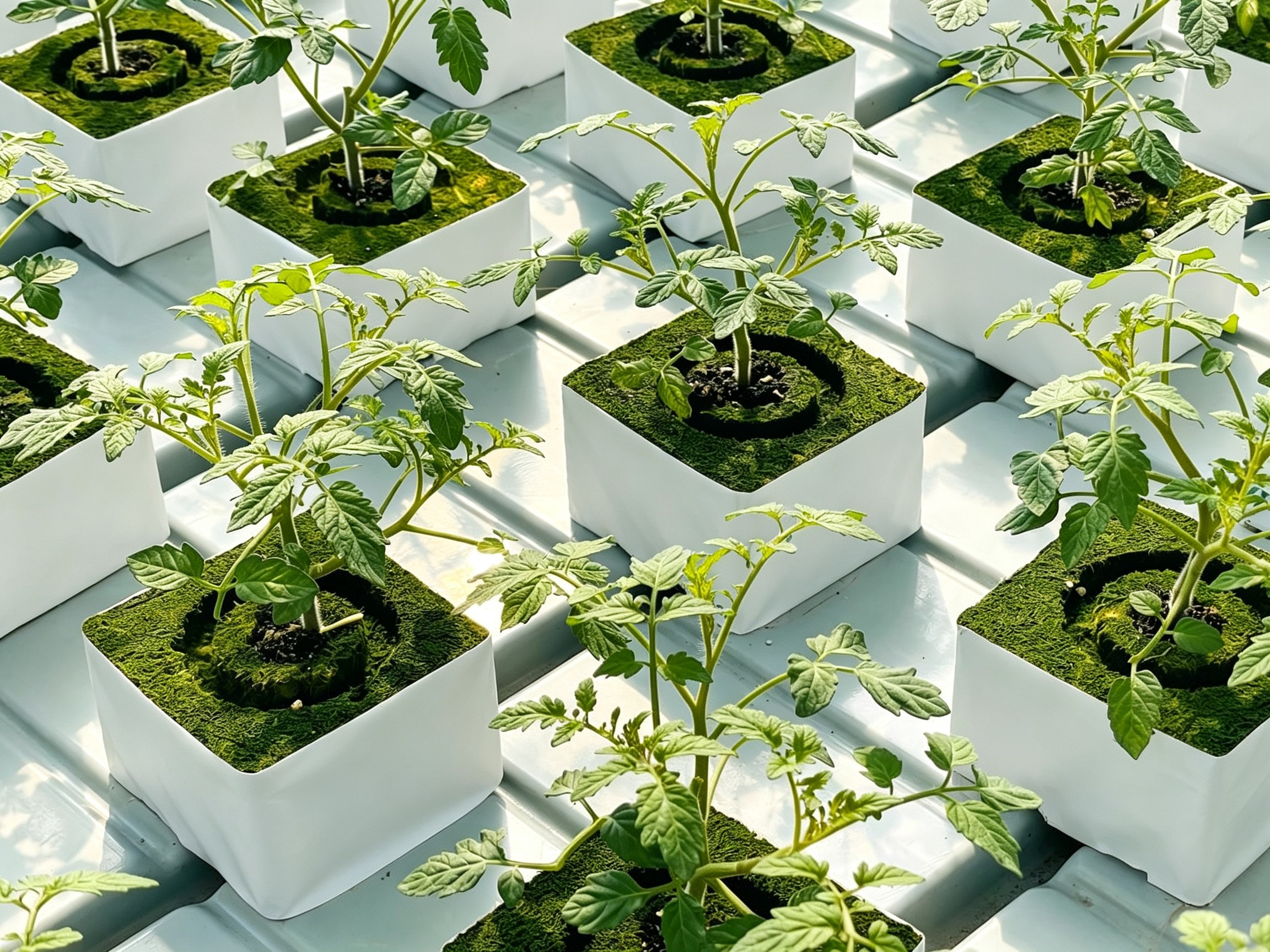
One common mistake is changing irrigation programs without first understanding how your rock wool growing media behaves.
Different substrates do not respond exactly the same way.
Fiber structure, density, water distribution, and air capacity all influence how quickly a rootzone absorbs, releases, and redistributes water.
That is why irrigation strategies should always be calibrated based on actual substrate behavior — not only on general recipes.
A simple but powerful method is to measure one fundamental relationship:
How much liquid goes IN, and how much comes OUT?
By tracking irrigation input versus drainage output, growers can understand:
- Water retention characteristics • Drainage speed • Rootzone stability • Irrigation efficiency
Data does not need to be complicated.
The right data creates clarity.
The 5% Rule: Avoid Over-Steering
Not every variation requires a complete strategy change.
If performance differences between substrate batches remain within approximately 5%, excessive adjustment may create more problems than solutions.
Precision growing is not about chasing every small fluctuation.
It is about understanding the system and making confident decisions.
Final Thoughts
Crop steering is not about having more sensors, more numbers, or more complicated programs.
It is about understanding the relationship between:
🌱 Plant behavior 💧 Water movement 🧱 Rootzone structure
P1, P2, and P3 provide the roadmap.
Rootzone feedback provides the steering wheel.
When growers understand this connection, precision growing becomes simpler, more predictable, and more profitable.
By mastering these P1 P2 P3 irrigation phases, growers can achieve more consistent crop growth and better control over plant development throughout the production cycle.
How do you currently monitor irrigation input versus drainage output in your greenhouse?
This article was originally shared on LinkedIn.Join the discussion on LinkedIn →