
For commercial greenhouse growers, sustainability is not only about reducing waste — it is also about improving operational efficiency while maintaining consistent crop performance.
One of the biggest challenges growers face today is:
How can we reduce substrate replacement costs without compromising root health yield, and crop security?
Recently, Grofine worked together with one of our agricultural partners on a practical case study:
Reconditioning used rock wool slabs for a second tomato cultivation cycle.
While some growers are exploring the reuse of rock
wool slabs to reduce operational costs and environmental impact, the key question remains:
How can we minimize the risks associated with root pathogens and nutrient imbalance?
The main concerns are usually related to:
🔸 Root diseases such as Pythium and Phytophthora
🔸 Residual root materials from the previous crop
🔸 Changes in EC, pH, and root-zone conditions
To address these challenges, we implemented a 3-step integrated root-zone management strategy:
Recondition Used Rock Wool Slabs: Sanitation Step
Before introducing a new crop cycle, used slabs should undergo proper sanitation procedures.
Depending on the cultivation system and local regulations, growers may apply sanitation solutions such as:
- Chlorine dioxide (ClO₂)
- Hydrogen peroxide-based treatments
The goal is to reduce potential pathogen pressure and create a cleaner foundation for the next crop.
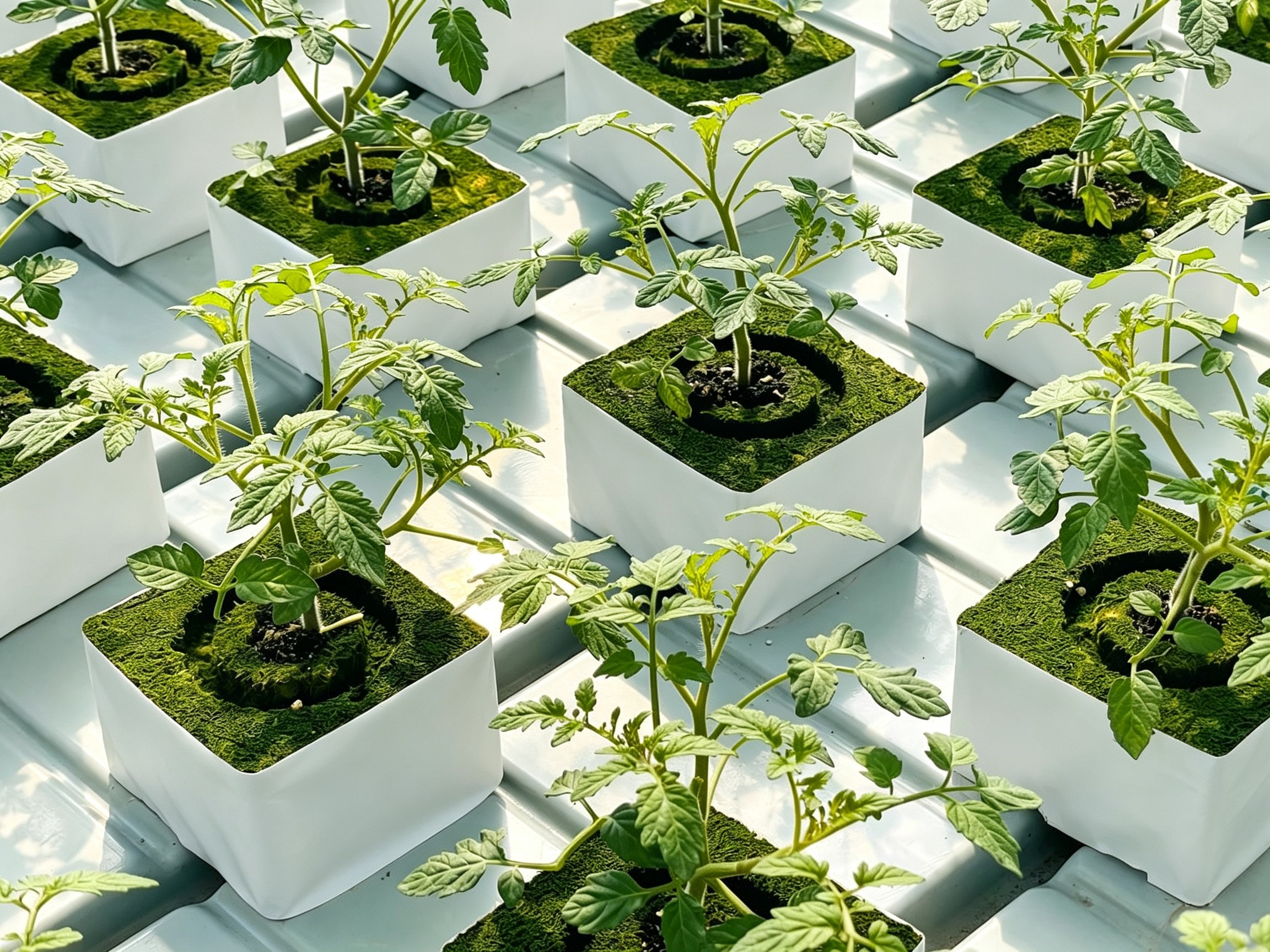
Starting Second Tomato Cycle with Healthy Rock Wool
A healthy beginning is one of the most important factors in crop success.
By combining:
✅ Disease-resistant grafted tomato seedlings
✅ High-density, sterile propagation blocks
✅ Optimized early root development
growers can establish a stronger root system and improve plant resilience during the early growth stage.
(Grofine propagation blocks are designed to provide stable water distribution, aeration, and root-zone consistency for professional greenhouse production.)
Microbial Management for Reused Rock Wool
After planting, introducing beneficial microorganisms through fertigation can help support a balanced root-zone ecosystem.
Common biological solutions include:
- Trichoderma
- Bacillusspecies
These beneficial microbes help occupy ecological niches around the roots and support natural disease suppression.
The Goal?
A more sustainable cultivation approach:
✅ Lower substrate replacement frequency
✅ Reduced operational costs
✅ Better resource utilization
✅ More stable root-zone management
However, successful substrate reconditioning requires careful evaluation of:
✔ Pathogen status ✔ EC and nutrient balance ✔ Physical structure of the slab ✔ Overall crop management conditions
At Grofine, we believe growing media is not just a product — it is a foundation for a complete cultivation system.
We work with growers worldwide to develop reliable and standardized hydroponic solutions for every stage of crop production.
💡 How does your greenhouse manage substrate turnover and root-zone health between crop cycles?
Let’s exchange ideas and experiences.
This article was originally shared on LinkedIn.Join the discussion on LinkedIn →